
.svg)
8 October 2021
Alex Whitebrook









October 8, 2021
With Australian AGM season around the corner, ESG issues look set to take centre stage as shareholder activism on environmental and social issues increases. This blog article is based on analysis from Minerva’s upcoming Australia Peak Season Preview briefing – contact hello@minerva.info for more information.
Annual General Meetings are an opportunity for shareholders to gather, ask boards questions and have input on future strategic direction, as well as vote on executive pay and director elections. One notable recent development in the market is the increased focus on environmental and social issues, with Australian shareholders showing a particularly keen focus on climate change.
ESG activism has increased in terms of number, prominence and impact, with the Australian experience of ESG related resolutions proposed by shareholders dwarfing previous experience in the last 20 years. However, Australian shareholders are faced with regulatory limitations on shareholder resolutions when compared to other jurisdictions.
Section 249N of the Commercial Act governs the mechanism for shareholders to file resolutions at a general meeting. Shareholders may file a resolution if they hold at least 5% of the voting rights, or if the resolution is filed by 100 or more shareholders entitled to vote at the meeting.
Whilst there is perhaps a low bar for the filing of shareholder resolutions, shareholders do not have the ability to file advisory non-binding resolutions in the market. Shareholder resolutions are considered a ‘decision’ of the company and are therefore binding and subject to a supermajority requirement of 75% votes in favour.
A company’s constitution governs decision-making rights for shareholders, and it is therefore common for shareholders to file a binding resolution seeking an amendment to the constitution to grant shareholders the right to propose advisory resolutions or to express an opinion. Filing this request gives shareholders the platform to propose advisory resolutions on other matters, such as climate change, at the same meeting. As the constitutional amendment resolutions are classified as special resolutions, shareholders struggle to find the required majority and no such proposal has been successful. If the constitution amendment fails, then any advisory resolution also filed at the meeting cannot pass as they are conditional on the amendment.
The current system makes it difficult for shareholders to hold public companies to account on issues they would like to express an opinion on. Whilst constitution amendments may help fix the issue on an individual company level, the issue would be better dealt with on a market-wide basis to ensure comparability. In light of the increasing shareholder activism, a regulatory review of the shareholder resolution regime would be timely and beneficial to both boards and shareholders. However, not all governance professionals support legislative changes to provide shareholders with greater scope to pass non-binding resolutions. Despite these challenges, the number of shareholder resolutions filed in the ASX100 has increased over time.
Figure 1: Shareholder Proposals in the ASX100
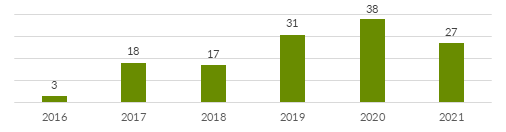
Data Note: 2021 covers shareholder resolutions logged by Minerva as at 08/10/2021.
The level of support on shareholder ESG resolutions has been increasing over time. The majority vote received on a shareholder resolution requesting AGL Energy Ltd to adopt stronger carbon-reduction goals at its AGM on 22/09/2021 could prove to be a watershed moment and a signal from investors to the market. However, as the corresponding constitution amendment resolution was not successful, the climate resolution was not carried despite the support shown and the board does not have to act on it.
One additional unique component of the Australian shareholder resolution process is that the filing of resolutions is highly concentrated, with the Australasian Centre for Corporate Responsibility (ACCR) and Market Forces behind the vast majority of resolutions.
Other Australian companies could face an ESG backlash from investors this season. The table below identifies key upcoming ESG votes shareholders and stakeholders will want to pay close attention to:
Company AGM Date Resolution Issue Proponent Commonwealth Bank of Australia Ltd 13/10/2021 Transition Planning Disclosure Market Forces Origin Energy Ltd 20/10/2021 Access to Clean Water Not Disclosed Origin Energy Ltd 20/10/2021 Cultural Heritage Protection Law Not Disclosed Origin Energy Ltd 20/10/2021 Traditional Owners Consent Not Disclosed Origin Energy Ltd 20/10/2021 Climate Lobbying ACCR Origin Energy Ltd 20/10/2021 Paris-aligned Capital Expenditure ACCR South32 Ltd 28/10/2021 Climate Lobbying* ACCR Fortescue Metals Group Ltd 09/11/2021 Cultural Heritage Protection Law ACCR BHP Group Ltd 11/11/2021 Climate Lobbying* ACCR BHP Group Ltd 11/11/2021 Climate Capital Protection Market Forces National Australia Bank Ltd 17/12/2021 Transition Planning Disclosure Market Forces Whitehaven Coal Ltd Expected October Climate Capital Protection Market Forces New Hope Group Ltd Expected November Climate Capital Protection Market Forces Australia and New Zealand Banking Group Ltd Expected December Transition Planning Disclosure Market Forces Westpac Banking Corp Expected December Transition Planning Disclosure Market Forces
* The BHP and South32 boards recommend shareholders to support the climate lobbying proposals.

%203-2.jpg)
.jpg)