7 January 2022
Alex Whitebrook

January 7, 2022
Environmental, social and governance (ESG) issues are increasingly at the forefront of debate in the Australian market and 2021’s AGM season proved no exception. With Australian shareholders continuing to use the ability to file resolutions as a way to draw attention and debate over ESG issues, this blog article provides an update to Minerva’s Australia AGM Season Preview briefings.
Contact hello@minerva.info for more information.
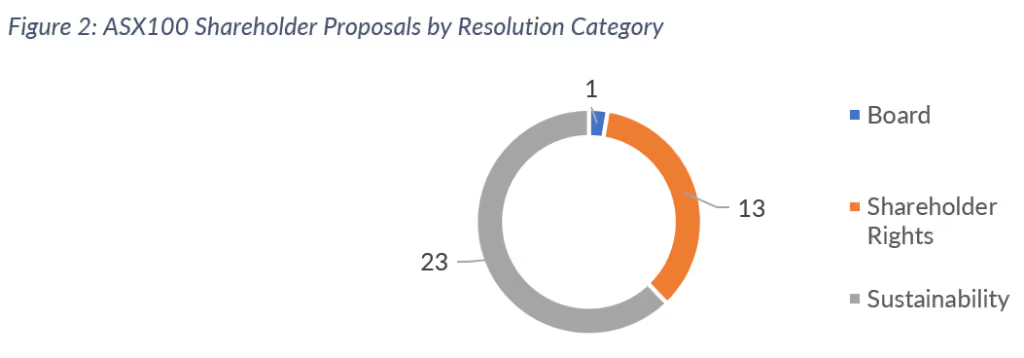
According to Minerva’s VoteWatch database, there were 37 shareholder proposals in the ASX100 in 2021, remaining relatively stable to last year’s 38 shareholder proposals.
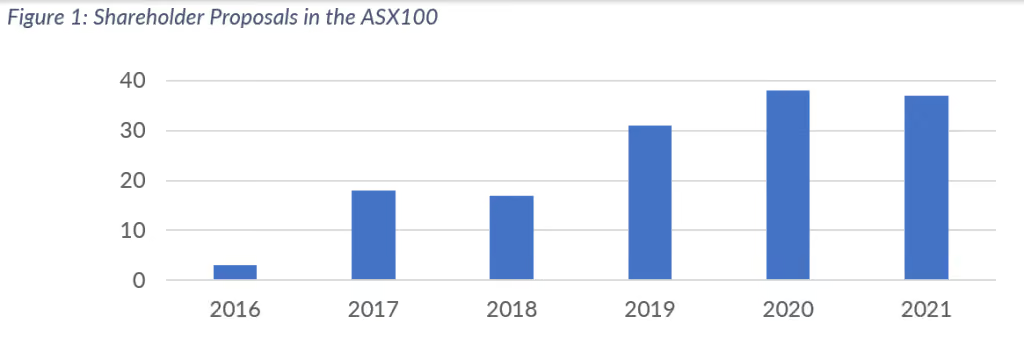
Around 60% of the shareholder proposals this year concerned sustainability issues, such as climate change – highlighting the importance of ESG issues for Australian shareholders.
In Minerva’s Australia AGM Season Preview, we highlighted the key upcoming ESG votes for shareholders in 2021. As an update, the table below details the ESG proposals voted on by shareholders in the 2021 season along with the voting outcome.
Most notable ESG developments in Australia's proxy season were related to climate policy.
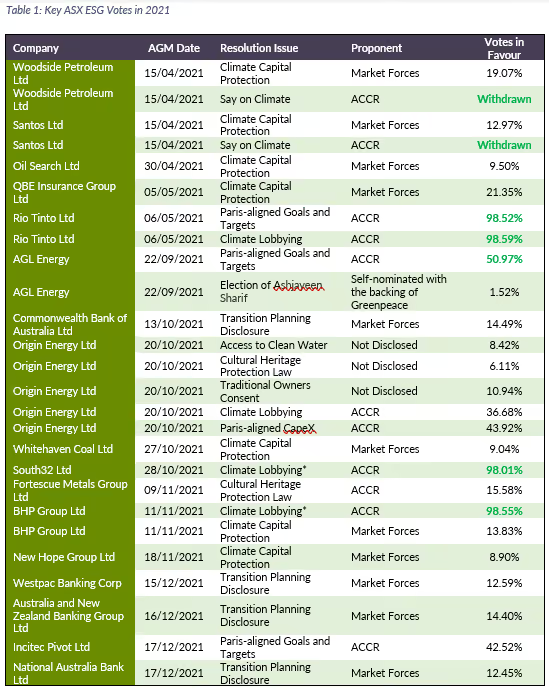
Despite the five majority support outcomes, only the shareholder proposals at Rio Tinto actually passed. The proposals at AGL, BHP and South32 were conditional on a shareholder proposal requesting a constitution amendment being successful. As the constitution amendment proposals did not receive the required majority, the climate proposals were not carried. This is a unique feature of the Australian market.
Management powers in Australia are typically vested exclusively with the directors, and the courts define a shareholder resolution as a ‘decision’ of the company. Therefore, shareholder resolutions are binding on the company and are subject to a supermajority requirement of 75% votes in favour. The company’s constitution governs decision-making rights for shareholders. There have been several shareholder resolutions seeking an amendment to the constitution to give shareholders the right to propose advisory resolutions or to express an opinion. Filing this request gives shareholders the platform to propose advisory resolutions on other matters, such as climate change, at the same meeting. As the constitutional amendment resolutions are classified as ‘special resolutions’, shareholders struggle to find the required majority and no such proposal has been successful. If the constitution amendment fails, then any advisory resolution also filed at the meeting cannot pass as they are conditional on the amendment.
The current system makes it difficult for shareholders to hold public companies to account on issues they would like to express an opinion on. Whilst constitution amendments may help fix the issue on an individual company level, the issue would be better dealt with on a market-wide basis to ensure comparability. In light of the increasing shareholder activism, a regulatory review of the shareholder resolution regime would be timely and beneficial to both boards and shareholders.
Despite the comparatively limited shareholder rights on resolutions in the market when compared to elsewhere and low success rate, in the 2021 season Australian shareholders continued to use the ability to file resolutions as a way to draw attention and debate over ESG issues.





Guest article by Frédéric Ducoulombier - EDHEC Climate Institute