.svg)
4 March 2019
Editor

Board evaluation, if done correctly, provides a vital tool for directors to strengthen board effectiveness. It provides an opportunity for boards to review its skills and experience; its composition and processes; and its activities and behaviours. Whether conducted internally or externally, regular board evaluations is widely recognised by regulators and business schools as as an essential part of good board governance.
One of the highlights of the failed outsourcer, Carillion plc’s annual report was the conclusion of the board evaluation that “the board, each of its committees and the directors continue to be highly effective” and that “Some of the key strengths highlighted by the 2016 evaluation included board composition and expertise” and “the board’s approach to risk management and internal control.”
New research by Minerva of board evaluation practices in the UK and Europe has identified a significant concentration in board evaluation firms with the UK's board evaluation market is dominated by just two firms, Lintstock Ltd and Independent Board Evaluation (Ffion Hague).
Although the total number of board evaluation firms is more varied than the external audit market, which is dominated by the ‘Big Four’ auditors, Minerva's findings are cause for concern.
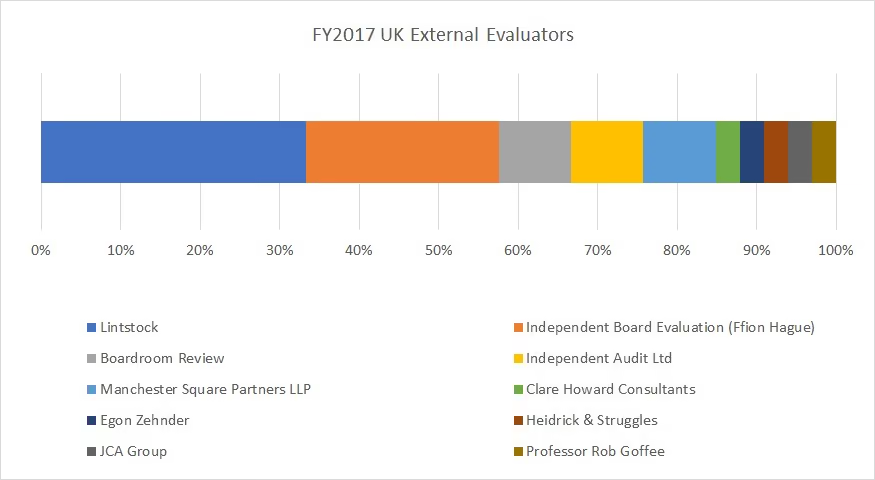
Good board governance is, of course, vital for investors. The role that evaluators play is therefore important, just as it is for external auditors for audit & reporting, recruitment firms for nomination & succession, and remuneration consultants for remuneration design. However, as well as market concentration, the governance framework for board evaluation is less developed when compared to other advisors.
Since 2010 the UK Corporate Governance Code has recommended that FTSE 350 companies should undertake an external board evaluation every three years.
Worryingly for investors, however, there is a lack of disclosure on the appointment, review of, and fees paid to board evaluation firms, as well as a general lack of discussion in annual reports about the impact of board evaluation. Together, this lack of transparency limits stakeholders' ability to assess the quality and effectiveness of board evaluation.
In respect of UK good practice, the 2018 Corporate Governance Code simply calls for the evaluator to be identified in the annual report and a statement made about any other connection it has with the company or individual directors. Furthermore, whilst coed of conduct have been published for head-hunters and remuneration consultants, there is currently no code of conduct for board evaluation.
Reflecting these concerns, respondents to the UK government’s consultation on the UK’s insolvency and corporate governance regime have suggested that the board evaluation market should be reviewed to ensure minimum standards.
As part of its review, the Government has asked the ICSA the professional body for company secretaries, to convene a group including representatives from the investment community and companies to develop a code of practice for external board evaluations. The Government has also asked the ICSA to consider other ways in which the quality and effectiveness of evaluations could be improved and whether shareholders should have a role in the appointment of an external evaluator.
Minerva's Briefing - Board Evaluation in Europe - is the latest of a series of topical policy notes on emerging governance themes and trends. Backed by in-depth analysis and drawing data from Minerva's wide-ranging governance systems, Minerva Briefings are free for clients but individual reports are available from our shop. Or for more information about Minerva's independent governance analytics, email hello@minerva.info