.svg)
7 October 2026
The Investment Association (IA) has urged companies to adopt hybrid AGMs over fully virtual shareholder meetings as the UK Government consults on reforms that could make online-only meetings easier to adopt.
The intervention comes at a pivotal moment in the debate over how shareholder meetings should evolve, with investors increasingly focused not on whether technology should be used, but on what safeguards are needed to preserve accountability as participation moves online.
As UK policymakers consider reforms that could facilitate virtual-only AGMs, investors are shifting attention from meeting technology itself to the safeguards needed to preserve shareholder accountability, transparency and meaningful board engagement
The IA's updated guidance outlines a series of safeguards that companies should adopt when using a virtual element in shareholder meetings. These include greater transparency around how questions are handled, publication of a full record of shareholder questions submitted during the meeting, and periodic shareholder reapproval of virtual AGM arrangements every three years. The guidance also states that boards should take responsibility for determining meeting format and clearly explain their reasoning to investors.
Taken together, the proposals are designed to prevent virtual meetings from becoming less transparent than physical gatherings. By requiring disclosure of all shareholder questions and periodic reapproval of meeting arrangements, the IA is seeking to ensure that digital formats remain subject to ongoing investor scrutiny rather than management discretion.
Representing investment managers overseeing more than £11.1 trillion (U$14.7 trillion) in assets, the IA argues that AGMs remain a critical accountability mechanism for shareholders. It describes hybrid meetings as the format best able to balance accountability, inclusivity and interactivity, while also expanding access for investors who may be unable to attend in person.
Miranda Beacham, Head of UK Responsible Investment at Aegon Asset Management and Chair of the IA Stewardship Committee, said the evolution of meeting technology makes it essential to establish safeguards that protect shareholder rights while ensuring AGM formats remain practical for both companies and investors.
The IA's intervention reflects longstanding investor concerns about fully virtual AGMs. Shareholders have reported difficulties accessing meetings, fewer opportunities to engage directly with directors and executives, and reduced scope for meaningful discussion on important governance issues.
For many investors, the concern is not simply whether questions can be asked online, but whether virtual-only formats can replicate the scrutiny and visibility that accompany physical meetings. These concerns have helped shape investor preference for hybrid models, which preserve in-person accountability mechanisms while allowing broader participation through digital channels.
Minerva Analytics has previously examined these risks in greater depth in a briefing focused on virtual-only AGMs, which highlighted that hybrid AGMs offer a more balanced approach than fully virtual alternatives.
The IA's guidance follows the UK Government's Modernising Corporate Reporting consultation, launched last month. Among other proposals, the consultation seeks to clarify that the legal "place" of a meeting could include virtual locations where shareholders have provided consent.
While the proposal would not require companies to adopt virtual-only AGMs, legal clarification could remove uncertainty that has historically acted as a barrier to adoption in the UK. As a result, investors are increasingly focused on the governance protections that should accompany any expansion of virtual meeting formats.
Responses are being sought until 30 November, with the consultation also exploring potential safeguards including enhanced consent thresholds, periodic shareholder reapproval requirements and supplementary guidance for companies adopting virtual meeting arrangements. The Government has not endorsed virtual-only AGMs and has acknowledged investor concerns regarding both shareholder rights and the practical operation of fully virtual meetings.
Responding to the consultation, Thomas Bolger, Senior Stewardship Analyst at Minerva Analytics, cautioned that making virtual-only AGMs easier to adopt "risks reducing both transparency and shareholders' ability to hold boards to account". Minerva Analytics has previously argued that hybrid formats offer a more effective balance between accessibility and shareholder accountability than fully virtual alternatives.
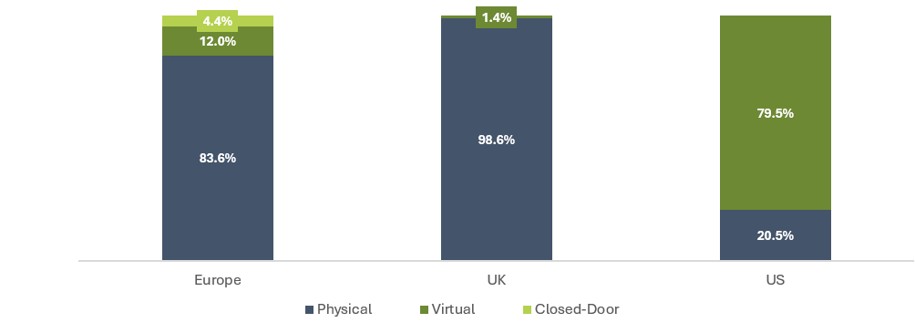
Minerva's 2026 Global Proxy Season Review found that virtual AGMs remain considerably less common in the UK than in Europe and the United States, where online-only meetings have gained wider acceptance. As shown in the figure below taken from our briefing, physical meetings continue to dominate the UK market at companies covered by Minerva Analytics.
Some investors nevertheless worry that legal clarification could encourage more UK companies to pursue virtual-only structures. Attention has particularly focused on sectors where AGMs regularly attract demonstrations or activist scrutiny. Banks and major energy companies have frequently faced protests at annual meetings, leading some investors to question whether fully virtual formats could be used to limit public accountability.
The issue came into sharp focus at BP's 2026 AGM, where shareholders rejected a proposed amendment that would have enabled the company to hold fully electronic general meetings. The proposal received only 42% support, well below the 75% approval threshold required to amend the company's Articles of Association.
The consultation will test whether policymakers can create a framework that accommodates technological change while maintaining confidence in shareholder oversight. The significance of the IA's intervention is that it shifts the debate from whether virtual meetings should exist to what conditions should govern them. As policymakers consider reform, the emerging battleground is likely to be safeguards rather than technology itself. Current investor opinion suggests hybrid meetings remain the preferred model for preserving accountability while expanding participation.
.jpg)