.svg)
20 November 2009
Sarah Wilson

Henry Ford is frequently misquoted as saying "History is bunk" what he actually said was: "History is more or less bunk. It's tradition. We don't want tradition. We want to live in the present and the only history that is worth a tinker's dam is the history we made today." Looking at the current state of the financial services industry, one of Ford's contemporaries, Louis Brandeis, may have preferred to side with George Santayana's sentiment: "Those who cannot remember the past are doomed to repeat it."
Louis Dembitz Brandeis (November 13, 1856 – October 5, 1941) was a United States Supreme Court Justice from 1916 to 1939. At the age of twenty he graduated from Harvard Law School with the highest grade average in the college’s history. In 1914 he wrote "Other People's Money and How Bankers Use It" , a direct attack on investment bankers and their role in promoting unfair competition and industrial consolidation.
As the regulatory debate about banker's pay and regulation reform rumbles on it's worth considering what Brandeis had to say on the same issues almost a century ago:
"But the compensation taken by the bankers as commissions or profits is often far from reasonable. Occupying, as they so frequently do, the inconsistent position of being at the same time seller and buyer, the standard for so-called compensation actually applied, is not the 'Rule of reason', but ''All the traffic will bear.' And this is true even where there is no sinister motive. The weakness of human nature prevents men from being good judges of their own deservings."
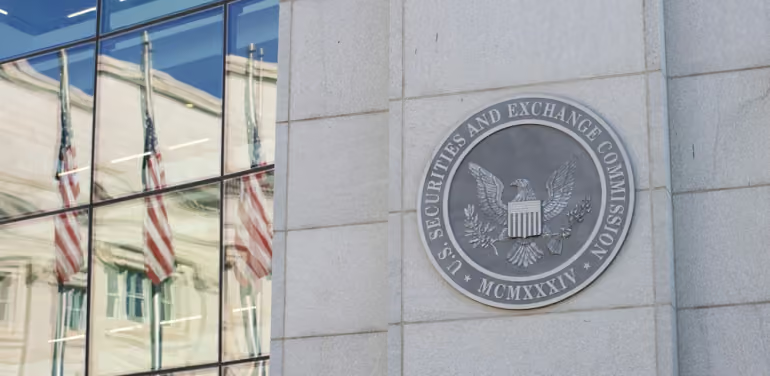
During the Great Depression “Other People’s Money” was widely read by Franklin Roosevelt’s "New Deal" administration which was instrumental for binging in the Glass-Steagall and the Securities Exchange Acts. These laws imposed new regulation of the banking system, requiring the separation of banking from stock brokerage, and established the Securities and Exchange Commission to regulate the stock markets.
As Brandeis' biographer, Melvin I. Urofsky, professor at Virginia Commonwealth University said: "For Brandeis, regulation was not supposed to be a restraint on innovation or the entrepreneurial spirit, but rather a check on unbridled greed. He believed in a free market, but one in which the government enforced rules of fair competition so that the most talented could succeed. Clear rules would help ensure that business was conducted fairly and openly. Good regulation will keep us from losing sight of the importance of those same principles that Brandeis emphasized so many years ago — honesty, openness and a fair playing field."
The University of Louisville, Brandeis' home town, has a complete on-line copy of many of his works, including Other People's Money, complete with original illustrations. It's well worth a read.
Other People's Money and How Bankers Use It >>
[amazon-product align="left"]0375423664[/amazon-product]








-1.avif)

Alex Whitebrook
.avif)