.svg)
21 January 2021
Elizabeth Pfeuti
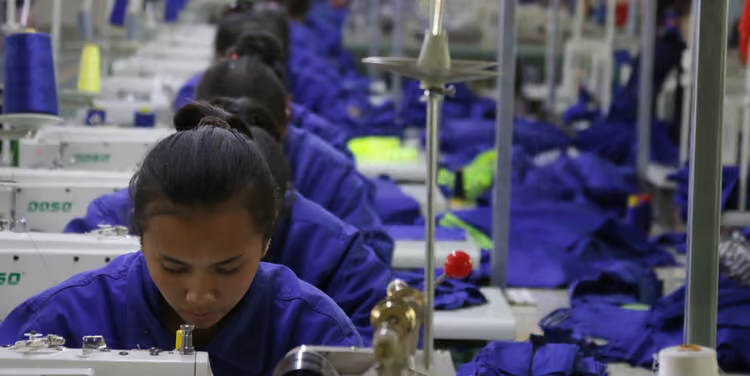
Marks & Spencer has become the first top-tier UK clothing company to formally announce it will cut all ties with suppliers that are connected to the forced labour of the Uyghur people.
The announcement came as China faces growing pressure from the international community over its treatment of Uyghur Muslims.
Richard Price, M&S clothing and home managing director, said: “At M&S, sourcing ethically and sustainably is core to how we do business and the promise we make to our customers, that’s why we do not source cotton from Xinjiang.”
The high street retailer has signed the Coalition to End Uyghur Forced Labour’s Call to Action, endorsed by 300 human rights and civil society organisations.
“When it comes to sustainable and ethical clothing, we can only achieve real change at scale by working with others, which is why we are proud to be formally supporting the coalition and providing additional assurance to our customers they can purchase from M&S with confidence,” Price said.
Over half a million Uyghurs and other minorities are forced to pick cotton in the Xinjiang region, according to a recent report from the Center for Global Policy.
Xinjiang currently produces more than 80% of China’s cotton, approaching almost 20% of global production.
Chief executive of Anti-Slavery International Jasmine O'Connor welcomed the move and praised M&S for its leadership.
She said: “The Call to Action sets out a clear path of action for brands to follow in line with the UN Guiding Principles on Business and Human Rights and we call upon other major brands to follow suit with M&S and commit to the Call to Action urgently.”
The UK is also introducing new rules to prevent the import of goods suspected of using forced labour in China’s Xinjiang province. Companies will now have to make sure their supply chains are free from forced labour in the Xinjiang province or risk fines.
Shareholder voting and human rights
Corporations are increasingly expected to speak out against human rights violations but are often reluctant to do so against foreign governments over fears of losing market access.
However, Apple has faced growing pressure from investors over its relationship with China. Last year, a shareholder proposal critical of the company’s app removals in China received a vote of 40.6%.
The proposal was in response to Apple’s decision to remove apps from its App Store that enable users to bypass China’s so-called Great Firewall and visit restricted sites. Apple’s decision to do this was widely seen as a move to preserve its access to China’s vast market.
While the shareholder proposal did not result in change, it was enough to make the company take notice.
Last September, the tech giant announced a new human rights policy aimed at improving the rights of workers following shareholder pressure and criticism of manufacturer conditions. However, critics argue that Apple needs to be clearer on how it will create proper oversight and measure progress.
Apple has previously voted down shareholder actions on human rights abuses in China by much larger margins. In 2018, it faced a shareholder proposal calling for a human rights panel to oversee issues such as workplace conditions in China, which was defeated by a vote of 94.4%.
Shareholders are becoming increasingly concerned about big tech’s negligence when it comes to human rights and equality issues.
Last year, 10 shareholder proposals were put up for vote at Google’s parent company Alphabet, ranging from gender and racial equal pay to reporting on sustainability metrics and a push for equal shareholder voting.
All 10 were rejected including three on human rights-related proposals. One proposal, requesting the establishment of a human rights risk oversight committee to help anticipate and oversee the management of the adverse human rights and societal risks, received just 16% of the vote.



Jack Grogan-Fenn
Elizabeth Pfeuti