.svg)
15 April 2022
Alex Whitebrook
April 15, 2022
Since the beginning of the Russian invasion of Ukraine, there have been reported sightings of Russian thermobaric rocket launchers in Ukraine. According to Oksana Markarova, Ukraine’s ambassador to the United States, Russia have already put these rockets to use. However, these reports remain unconfirmed. This article will bring you through what you need to know about how these weapons, the consequences of using them and where we have seen them before.
Thermobaric weapons/munitions can also be known as aerosol bombs, fuel-air explosives, or vacuum bombs. They use oxygen from the air for a large, high-temperature blast. The bombs go off in two separate stages. As they hit the target, a first explosion opens the bomb’s fuel container, releasing a cloud of fuel and metal particles that spreads over a large area. A second explosion then occurs, igniting the aerosol-cloud into a giant ball of fire and sending out intense blast waves that can destroy even reinforced buildings and vaporise human beings.
Thermobaric bombs can be mistakenly categorised under either cluster munitions due to their two-stage detonation or incendiary weapons. However, they are rather, ‘explosives’ or ‘enhanced blasts’. Under the 2008 Convention on Cluster Munitions, countries are prohibited from using cluster munitions. There are currently 110 signatories, neither Ukraine nor Russia are signatories. There is currently no comparable convention for thermobaric bombs and there is no international law banning their use.
Human rights groups such as Amnesty International and Human Rights Watch have stated that the use of these weapons to indiscriminately attack civilian infrastructure, schools and hospitals, killing or injuring civilian populations, will constitute a war crime and the aggressor could be convicted under the Hague Conventions of 1899 and 1907.
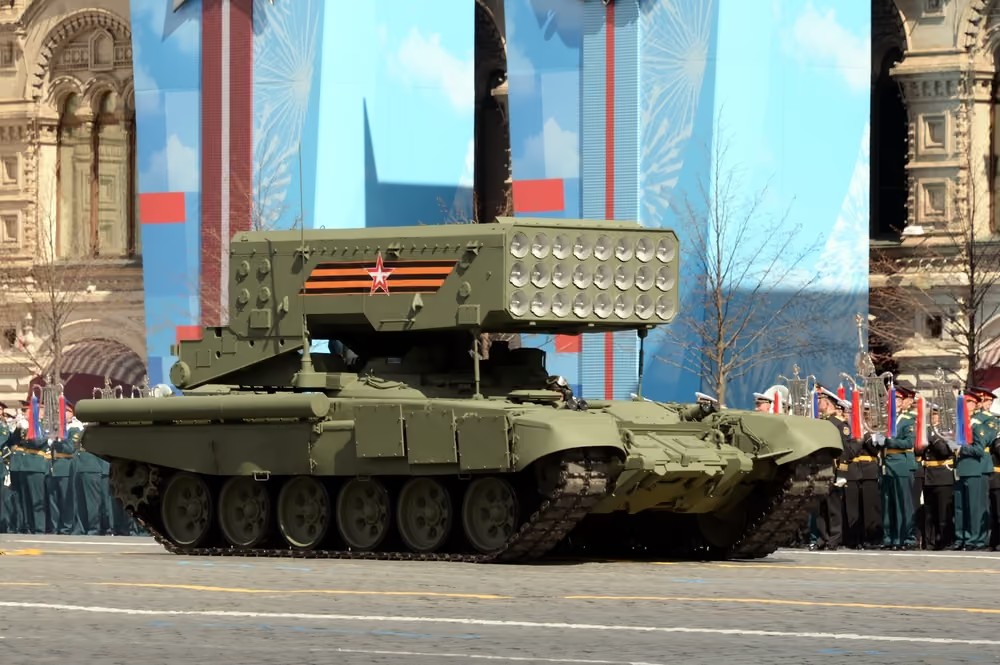
Russia’s most well-known thermobaric weapons are the TOS-1A systems that sit on a T-72 Tank Chassis. It is currently reported that these systems are made by the Russian machine industry company – Uralvagonzavod. Uralvagonzavod is a wholly-owned Russian-state company that produces military equipment for the Russian Armed Forces. The company was previously sanctioned after the annexation of Crimea by Russia in 2014. It continues to be financially sanctioned by the US, UK and EU this year due to the company's strategic significance in threatening the sovereignty of Ukraine.
Russia’s TOS-1A systems at a defence exhibition in 2021
The Russian invasion of Ukraine is not the first time we have come across Russia’s use of thermobaric weapons. Russia was found to have used them during the 1999 Chechnya war. Similarly, Russia is reported to have supplied the Bashar al-Assad regime with thermobaric weapons during the Syrian war. The Office of the United Nations High Commissioner for Human Rights (OHCHR) recorded Russia’s supply and subsequent use of these weapons which indiscriminately attacked civilians in Syria as a war crime.
Here at Minerva, we offer an ESG screening service on indices through our partnership with Solactive, a custom index provider. Within this service, we screen for several controversial weapons such as cluster munitions, nuclear weapons, and anti-personnel mines. Therefore, it is essential we keep up to date with the latest conflicts, the weapons used and those who directly contribute to conflict and weapon development.

.jpg)