.svg)
13 March 2026

A proposal from ExxonMobil to shift its legal domicile from New Jersey to Texas lands at a moment when shareholder proposals have all but disappeared from its annual meetings and the company has introduced new structures that reshape how shareholder votes are cast and counted.
Shareholders will vote on the redomicile at Exxon’s virtual‑only annual general meeting on 27 May 2026. If approved, it would mark the company’s first change in legal domicile since its incorporation as Standard Oil of New Jersey in 1882. Exxon has characterised the move as a technical alignment, arguing that Texas better reflects where its leadership, workforce and operations have been based since 1989.
In its preliminary proxy filing, the company pointed to Texas’ modernised business statutes and the creation of a specialist Texas Business Court as offering greater predictability when corporate decisions are challenged. The board has also stated that shareholder rights under Texas law are largely comparable to those under New Jersey law, and that it does not intend to adopt optional provisions that would weaken existing protections.
The proposal, however, comes against the backdrop of a marked shift in Exxon’s shareholder engagement profile. The company faced no shareholder proposals at its 2025 AGM. That absence represented a sharp break with recent history. Since its 2016 AGM, Exxon had faced at least four shareholder proposals at each annual meeting, with numbers peaking at 13 resolutions at its 2023 AGM, according to Minerva Analytics data.
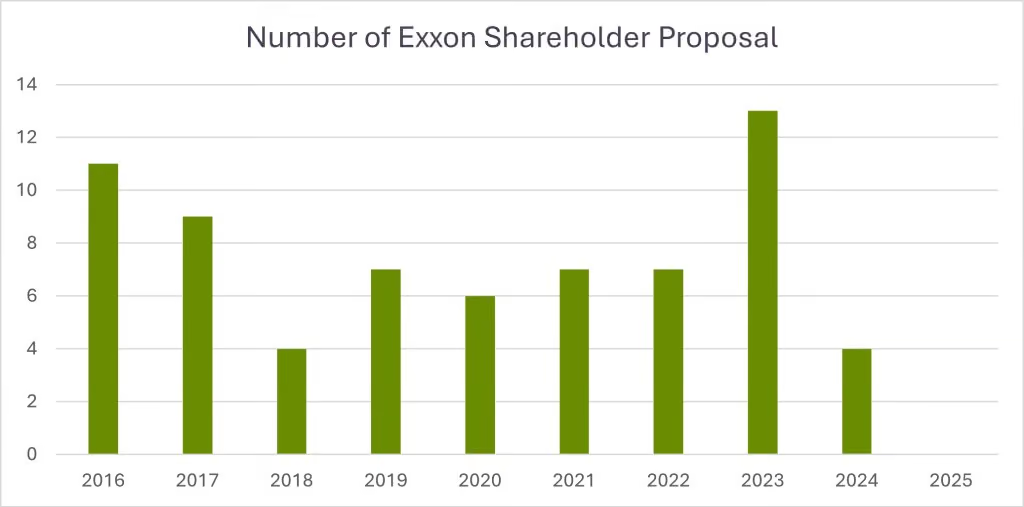
Several of those proposals attracted substantial investor support, with some passing outright. In 2021, shareholders approved resolutions requesting reports on lobbying and climate lobbying. A further proposal requesting scenario analysis was approved in 2022. Those votes underlined that shareholder proposals at Exxon had, at times, driven substantive governance outcomes rather than serving a purely signalling function.
Exxon has so far published only a preliminary proxy statement for its 2026 AGM. Any shareholder proposals, if there are any, will be disclosed in the definitive proxy statement, which in recent years has been issued in early April. Whether the absence of proposals at the 2025 meeting proves temporary or structural will therefore be closely watched.
Alongside the narrowing of its shareholder agenda, Exxon has made increasing use of procedural tools. The company filed at least one ‘no action’ request with the US Securities and Exchange Commission seeking to exclude a proposal from a trade union requesting that the roles of chair and chief executive be separated. Both positions have been held by Darren Woods since 2017. This week, fellow oil and gas giant BP was at placed at risk of being sued by Follow This for excluding a climate-focused proposal from its 2026 AGM in controversial circumstances.
Consistent with the SEC’s revised approach for the 2026 proxy season, the Commission did not formally endorse the exclusion but stated that it would not object if the company chose to proceed. This has become a common outcome since the regulator signalled it would not substantively review most no‑action requests during the current season.
Exxon has also introduced a Retail Voting Program allowing retail shareholders to opt into standing voting instructions that automatically align their votes with board recommendations. The initiative has been criticised by shareholder advocates, including As You Sow and the Interfaith Center for Corporate Responsibility, as entrenching management and diluting meeting‑specific shareholder judgement. It has also been challenged in court.
Taken together, Exxon’s proposed redomicile, the contraction of shareholder proposals, greater reliance on procedural exclusions and the rollout of automated retail voting mechanisms suggest a more managed environment for shareholder challenge and escalation.
For stewardship and engagement teams, the vote in May underscores broader questions about how engagement and escalation function in practice, particularly where companies are reshaping voting and governance frameworks amid reduced regulatory scrutiny.

.jpg)