.svg)
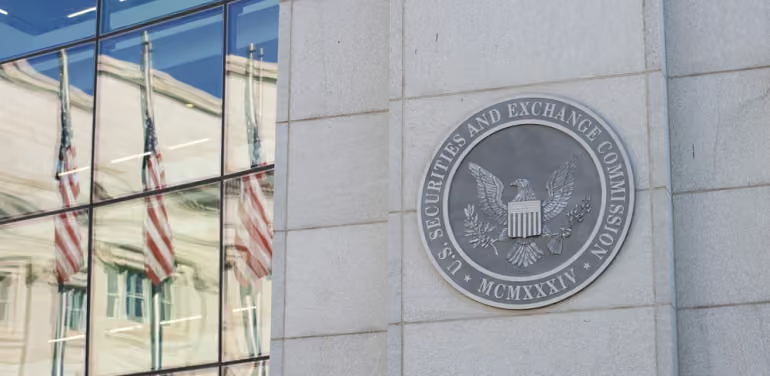
The US Securities and Exchange Commission (SEC) has taken its first formal step toward dismantling the federal climate disclosure framework, submitting a proposed rescission of the 2024 rules to the White House Office of Management and Budget (OMB) earlier this month. The move shifts the debate from legal limbo to active rollback, with immediate implications for how climate risk will be disclosed in US capital markets.
At the Chairman’s direction, SEC staff are now preparing an official recommendation that the Commission rescind the rules adopted under the Biden administration. An SEC spokesperson confirmed that the agency is no longer seeking to revive or defend the regime and is instead beginning a new rulemaking process that would remove it entirely.
The OMB submission matters because it changes the posture of the issue. For much of 2024 and 2025, the climate rules were suspended by litigation and rendered inert by Commission inaction. Rather than waiting for the courts to decide their fate, the SEC is now asserting control over the outcome and resetting expectations for issuers and investors who had been waiting for clarity.
The rules themselves were adopted in March 2024 under then Chair Gary Gensler and marked the SEC’s first attempt to mandate standardised, climate related disclosures for public companies. In their final form, they required disclosure of material climate risks, governance and risk management processes, and the financial impact of severe weather and other climate related events. Scope 3 emissions requirements were removed, and the framework was explicitly grounded in financial materiality.
Despite that narrowing, the rules were immediately challenged by a coalition of states and business groups and were stayed before taking effect. Following the 2024 election and Gensler’s resignation, the Commission reversed course. In March 2025 it voted to end its legal defence of the rules and later confirmed it would not revisit them while litigation continued.
That stance prompted a September 2025 order from the US Court of Appeals, which declined to rule on the merits and instead returned the decision to the agency, stating that it was the SEC’s responsibility to determine whether the rules would be rescinded, modified or defended. The OMB filing is the Commission’s first concrete response.
Although the direction of travel is now clearer, unwinding the rules will not be quick. The SEC must publish a proposed rescission, explain its legal basis, and run a public comment process. It will be required to engage with substantive comments, and any final decision could itself be challenged in court.
The agency has designated the proposal as an “economically significant” rule, signalling that it recognises the potential impact on markets and issuers. The working title, “Rescission of Climate Related Disclosure Rules”, makes clear that this is a wholesale reversal rather than a technical adjustment.
In public statements, the SEC has framed the shift as a return to core principles. Under Chairman Paul Atkins, the Commission says it is refocusing on its statutory mandate and a materiality based approach to disclosure, aligned with its view of legal authority.
For issuers, the immediate effect is not deregulation but prolonged uncertainty. Many large companies have already invested in climate risk assessment, governance structures and emissions measurement, driven by investor expectations and international regulation as much as by the SEC rule itself. Others delayed significant action in the expectation that US requirements might never take effect.
A drawn out rescission process risks extending this uneven landscape. Companies are left without a federal baseline while still facing questions from investors, proxy advisers and, in some cases, state regulators about how climate risks are identified, governed and managed.
The impact varies by issuer profile. Multinationals and companies with EU exposure must comply with the Corporate Sustainability Reporting Directive and similar regimes regardless of US policy. For them, the SEC’s retreat does little to reduce reporting burdens and may increase complexity by removing alignment with a domestic framework. US only issuers may face fewer formal obligations, but are unlikely to avoid scrutiny altogether, particularly in sectors where physical or transition risks are already affecting financial performance.
This move by the SEC tests their credibility with investors, who argued during the original rulemaking that climate risk is already financially material and that inconsistent voluntary disclosure impairs price discovery. By stepping back from a federal standard, the Commission is placing greater weight on issuer specific judgments of materiality, at the cost of comparability across the market.
Whether that trade off proves durable will depend less on rhetoric than on investor behaviour. Asset managers and analysts will continue to seek comparable data, and in the absence of a federal baseline, may rely more heavily on overseas standards or firm specific expectations.
The SEC’s move should not be read as the end of climate disclosure for US companies. Global regulatory momentum continues, and market norms have evolved faster than US rulemaking. The likely outcome is divergence rather than deregulation, with disclosure expectations increasingly shaped outside Washington.
For boards and management teams, the strategic question is whether climate disclosure is treated narrowly as a compliance obligation or embedded more deeply in risk management and governance. That choice will shape how resilient companies are to future regulatory shifts, whether domestic or international.
The next milestone is the publication of the proposed rescission and the opening of the comment period. The substance of investor submissions, and the SEC’s response to them, will be closely watched.








.jpg)

.jpg)