.svg)
4 January 2023
Elizabeth Pfeuti
January 04, 2023
Nearly 200 governments have entered into a landmark biodiversity agreement, but critics have argued this already requires reform.
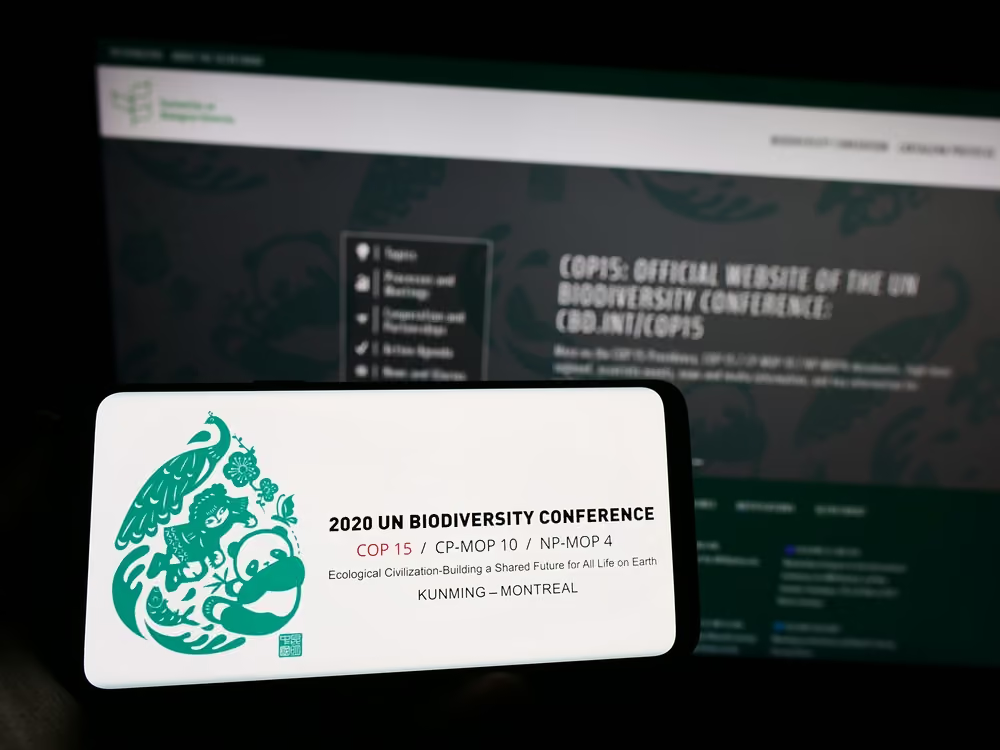
One hundred and eighty-eight governments have signed the Kunming-Montreal Global Biodiversity Framework (GBF), which prioritises the prevention and restoration of nature loss.
The landmark agreement was created to protect at least 30% of the planet’s lands and water by 2030 to restore biodiversity levels.
It was signed at the United Nations Biodiversity Conference (COP15), which ended in Canada on 19 December.
Inger Andersen, executive director of United Nations Environment Program (UNEP), said: “Success will be measured by our rapid and consistent progress in implementing what we have agreed to. The entire UN system is geared to support its implementation so we can truly make peace with nature.”
The 14-page agreement features 23 targets, which governments should aim to achieve by 2030.
These include proposals to halve global food waste and reduce the loss of areas with high biodiversity importance to near zero.
The agreement also acknowledges the important role finance plays in addressing biodiversity loss.
A target of mobilising at least $200bn per year from public and private sources for biodiversity-related funding has been established.
The framework also aims to raise international financial flows from developed to developing countries to at least $30bn per year.
However, the GBF framework has already received criticism.
Amnesty International has criticised the agreement for failing to protect indigenous peoples’ rights and not recognising their lands as a separate category of conserved area.
Indigenous peoples’ lands host 80% of the world’s biodiversity, despite only representing 5% of the world’s population.
As a result, the framework’s lack of recognition of Indigenous peoples’ lands ultimately threatens their rights according to the non-profit.
Chris Chapman, adviser on Indigenous Rights for Amnesty International, said: “States have failed to fully recognise Indigenous peoples’ immense contribution to conserving biodiversity, putting them at greater risk of human rights violations.”
The non-binding element of the agreement has also received criticism.
According to the German search engine Ecosia, an organisation built around environmental conservation, governments should instead be open to penalties if they fail to meet these targets.
Ecosia, which uses profits to plant trees, believes governments must strengthen the legal and regulatory framework for successful implementation.
Sophie Dembinksi, head of policy and UK at Ecoasia, said: “We need to look at an international law on ecocide – to be upheld by the international criminal court – that could serve to deter the most damaging practices that underpin systemic biodiversity loss, avert major disasters, and realign businesses’ relationship with nature in the long term.”
Prior to the creation of the framework at COP15, the Global Reporting Initiative (GRI) published its latest Biodiversity Standard in December.







Guest article by Frédéric Ducoulombier - EDHEC Climate Institute