.svg)
28 November 2019
Elizabeth Pfeuti
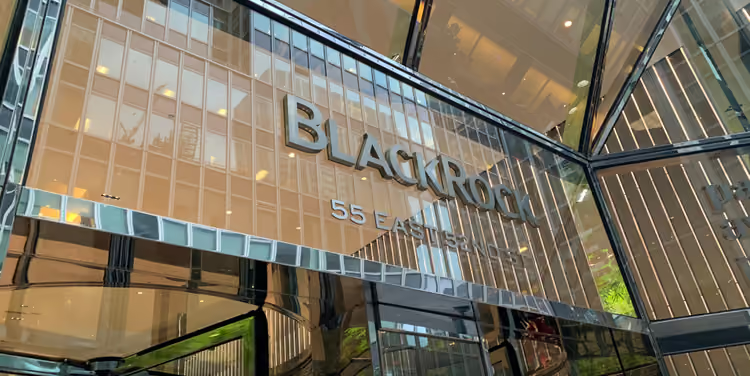
A group of investors are urging industry giants BlackRock and JPMorgan to review their proxy voting records amid concerns they don’t match the firms’ public declarations about climate change.
Mercy
Investment Services and Boston Trust
Walden have written to BlackRock and JPMorgan respectively, expressing
disappointment that the companies’ voting
practices appear inconsistent with their statements about the urgent need to
tackle environmental issues.
“This contradiction poses reputational risk for the
company with both clients and investors. Moreover, proxy voting practices that
ignore climate change seem to ignore significant company-specific and
economy-wide risks associated with negative impacts of climate change,” Mercy
Investment’s letter to BlackRock states.
As a result, the investors have filed shareholder
proposals requesting BlackRock and JPMorgan undergo a review of their proxy
voting policies and report back on any changes they’ll make.
According to BlackRock’s 2019 proxy voting record, the investment titan voted against virtually all climate-related resolutions, voting for only six out of the 52, which included requests for better disclosure and adoption of greenhouse gas reduction goals.
In contrast, investment firms such as PIMCO, Allianz,
Alliance Bernstein and MFS supported the majority of these climate-related
resolutions.
BlackRock’s record in 2018 was no better. A review by
Ceres found the investment firm only voted in favour of climate-related investor proposals a lowly 10% of the time,
putting it near the bottom of the table in terms of shareholder action and
support.
This is despite BlackRock
publicly warning about the risks of global warming on investor portfolios. It
also voted to require oil behemoth Exxon Mobil to
produce a climate change report back in 2017, which at the time was regarded as
a milestone in investor-led climate efforts.
Backing up Mercy Investment’s
sentiments, Boston Trust Walden’s letter to JPMorgan warned that a review of the
banking mammoth’s proxy voting record was both “important and timely”.
“At present the bank votes against troubling environmental
and social issues while voting for a number of governance changes, a curious
division in proxy voting,” the letter states.
JPMorgan’s 2019 proxy voting record reveals
it voted in favour of just two out of 52 climate change resolutions, despite
the company declaring on its website that it has
taken a lead in “addressing the challenges and opportunities of a
carbon-constrained environment”.
The firm also boasts
about being a founder of a New York Green Exchange, which provides environmental
futures, options and swap contracts for markets focused on solutions to climate
change and renewable energy.
And like BlackRock, JPMorgan
is also a member of the UN-backed Principles for Responsible Investment, the
leading organisation that encourages investors to vote conscientiously on ESG
issues.
Boston Trust’s criticism
of JPMorgan is not the first time the bank has come under shareholder scrutiny.
Its chairman and CEO
Jamie Dimon has frequently clashed with investors over his large pay packages,
while shareholders have
been calling on the banking giant to split the chair and CEO role to boost the
board’s effectiveness and transparency.
So far, these calls have
fallen on deaf ears.
Dimon also raised eyebrows in 2015 when
he dubbed shareholders “lazy” for following recommendations from proxy advisers
on how they should vote.
In addition, a recent report by
influential environmental group Rainforest Action Network (RAN) named the
JPMorgan as the biggest funder of fossil fuels and fossil fuel expansion. According
to the report, its volume of finance for fossil fuels between 2016 and 2018 was
a shocking 29% higher than the second-placed bank, Wells Fargo, standing at
$196bn.
An investigation by The Guardian
earlier this year also found BlackRock had a massive $87.3bn of shares in oil,
coal and gas companies.