.svg)
7 February 2020
Editor

Investors up in arms over SEC climate
proposals
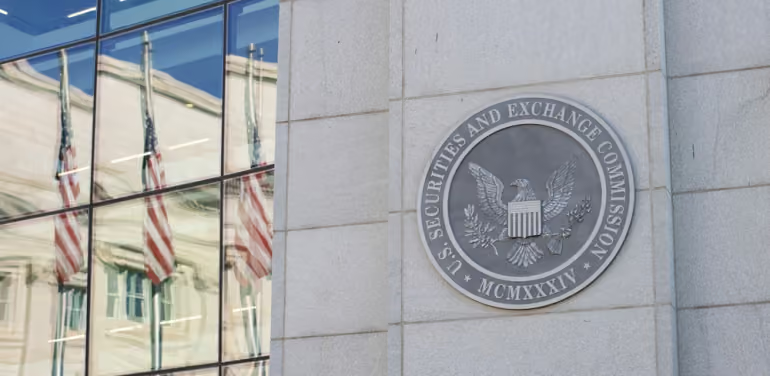
SEC chairman Jay Clayton has again come under fire for failing to go far enough on climate disclosures, as the regulator pushes to give company bosses yet more control over the information they divulge to investors.
SEC commissioner Allison Lee, an experienced securities law
practitioner, spoke out against Clayton and his cohorts over the proposed
overhaul of rules governing how corporations disclose financial information.

Ms Lee questioned why the changes fail to include any mention of
climate change disclosures, despite overwhelming demand from shareholders for
this data.
While Clayton states the proposed amendments to Regulation S-K, which
sets disclosure requirements for US public companies, would simplify the
disclosure process for all parties and would not “adversely affect investor
protection”, the change places more power in the hands of company executives,
effectively allowing them to keep more from investors.
Under the changes, firms would no longer be required to provide the
previous five years of selected annual financial data or the previous two years
of selected quarterly financial data to the SEC.
Other amendments include scrapping the requirement to discuss
off-balance sheet arrangements that are likely to have an effect on a company’s
financial condition, and replacing it with a framework that encourages
companies to discuss these arrangements in the context of managing the overall
business.

"The improved disclosures would allow investors to make better
capital allocation decisions, while reducing compliance burdens and costs
without in any way adversely affecting investor protection," Clayton said.
However, commissioner Lee attacked the proposals, noting they make no
attempt to address investors’ need for standardised disclosure on climate
change risk.
Ms Lee criticised the SEC for being “conspicuously silent” on climate change, adding the regulator risks falling behind international efforts and putting US companies at a competitive disadvantage globally.
“The Commission last addressed climate change disclosure in 2010. In
that guidance we identified four existing items in Regulation S-K that may
require disclosure related to climate change:
description of business, legal proceedings, risk factors, and
management’s discussion and analysis of financial condition and results of
operations, or MD&A.
“We have now proposed to modernise every one of these four items
without mentioning climate change or even asking a single question about its
relevance to these disclosures,” Lee said.
In 2016, the SEC requested comment on existing disclosure requirements
in Regulation S-K.
According to a survey from Sustainability Accounting Standards Board,
an overwhelming two-thirds of the more than 276 non-form comment letters the
Commission received in response addressed sustainability-related concerns, and
over 80% of those letters called for improved information in SEC filings, with
only 10% opposing SEC action on this subject.
The growing number of climate change-related resolutions put forward by
shareholders also highlights this demand for more transparency.
Already this year, shareholders have tabled climate change-related resolutions against big-name companies including Chevron, Exxon and Phillips 66 following concerns their lobbying activities don’t align with their public declarations to help tackle the climate crisis.
Commenting further on the proposals, Lee said she feared the changes
eliminate significant disclosure items, while “laudably enhancing others” and
questioned the SEC’s motive for moving towards principles-based disclosures.
“As with our last Regulation S-K proposal, these proposals heavily
favour a principles-based approach rather than balancing the use of principles
with line-item disclosure,” Lee stated.
“I continue to be concerned that the increased flexibility and
discretion that this approach affords company executives may result in
significant costs to investors - both if materiality is misapplied and through
the loss of important comparability in disclosure,” Lee warned.








.jpg)

.jpg)