.svg)
19 October 2017
Editor
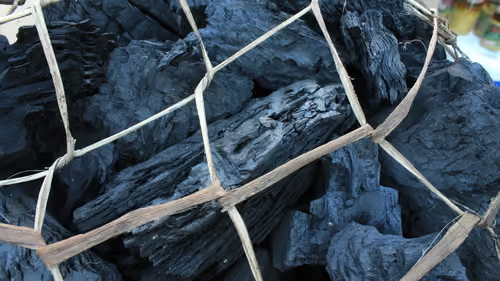
Anglo-Australian mining giant Rio Tinto has been fined £27m by the Financial Conduct Authority (FCA) for breaching UK disclosure rules while the US Securities & Exchange Commission has charged the company and former executives with fraud in relation to the acquisition of a coal mine in Mozambique in 2011. Rio Tinto is also being investigated by the Australian Securities & Investments Commission.
The FCA decided that Rio Tinto showed "a serious lack of judgement" when it failed to carry out an impairment test relating to the loss of value of the mine. If the company had met its obligations under the UK's listing rules regime to carry out the test the FCA said a material impairment would have been required to have been disclosed at the time of its 2012 half-year financial reporting in August that year. As it did not the FCA said Rio Tinto’s financial reporting was therefore inaccurate and misleading.
Rio Tinto finally announced an impairment of the Mozambique assets, writing off approximately 80% of the value of the investment in the Mozambique mine in January 2013. The FCA said that when Rio Tinto acquired the Mozambique mine, its valuation was based on a plan to move rapidly into coal production. This plan assumed Rio Tinto would be able to barge coal from the mines down the Zambezi River to the coast for export but it became apparent that this would not be possible.
The FCA said Rio Tinto began to carry out financial modelling of its mining business which indicated that the value of the Mozambique assets, based on the best information available at that time, was negative. However, it did not carry out an impairment test, as required by international accounting standards, to assess whether an impairment was required to be recorded in its financial reporting of its 2012 half year interim results. Instead, Rio Tinto decided there was a lack of clarity around how it would develop the mines which made it premature to revalue these assets. For this reason, and wrongly the FCA decided, Rio Tinto believed it was appropriate to continue to value the mining assets at the acquisition price.
Mark Steward, executive director of enforcement and market oversight, said: "The UK listing regime requires listed companies to adhere to high standards of disclosure and transparency. Rio Tinto should have been aware of its obligation to carry out the impairment test and the resulting material impairment should have been reported to the market at its half-year results in 2012. Reflecting the size of the company, this is the largest fine imposed to date by the FCA for a breach of rules relating to a firm’s official listing and demonstrates how vitally important high standards of disclosure and transparency are to ensuring our markets function fairly and effectively."
The SEC meanwhile has alleged that the actions of Rio Tinto and its former chief executive Thomas Albanese, and its former chief financial officer Guy Elliot regarding the mining operations, which were acquired for $3.7 billion in 2011 and sold in 2014 for $50 million, amounted to fraud. The US regulator has filed a complaint in the federal court in Manhattan which alleged that as the project suffered several setbacks resulting in the rapid decline of the value of the coal assets, the executives sought to hide or delay disclosure of the nature and extent of the adverse developments from Rio Tinto’s board of directors, audit committee, independent auditors, and investors.
Stephanie Avakian, co-director of the SEC’s Enforcement Division said: "Rio Tinto’s top executives allegedly breached their disclosure obligations and corporate duties by hiding from their board, auditor, and investors the crucial fact that a multi-billion dollar transaction was a failure.”
The SEC sought permanent injunctions, return of allegedly ill-gotten gains plus interest, and civil penalties from all the defendants, and sought to bar Albanese and Elliott from serving as public company officers or directors. The SEC said the acquisition of the coal assets in Mozambique came shortly after the disclosure of huge losses associated with its previous large-scale acquisition of Alcan. As well as finding that the coal could not be shipped out by barge the SEC said the executives also discovered that there was less coal and this was of a lower quality than expected.
The complaint alleges that after already impairing Alcan twice, Rio Tinto, Albanese, and Elliott knew that publicly disclosing its second failure and rapidly declining value would call into question their ability to pursue the core of Rio Tinto’s business model to identify and develop long-term, low-cost, and highly-profitable mining assets. Instead, the SEC alleged that Rio Tinto concealed the adverse developments, allowing Rio Tinto to release misleading financial statements days before a series of U.S. debt offerings. Rio Tinto raised $5.5 billion from U.S. investors, approximately $3 billion of which was raised after May 2012, when executives at Rio Tinto Coal Mozambique had already told Albanese and Elliott that the subsidiary had lost value. The complaint alleges Albanese then repeated and reinforced the false positive outlook for the project in public statements.
Rio Tinto said it intends to vigorously defend itself against the SEC's allegations. There has been a report in the Australian media that a class action against the company could be launched by investors following the fraud allegations in the US.








.jpg)