.svg)
14 January 2021
Elizabeth Pfeuti
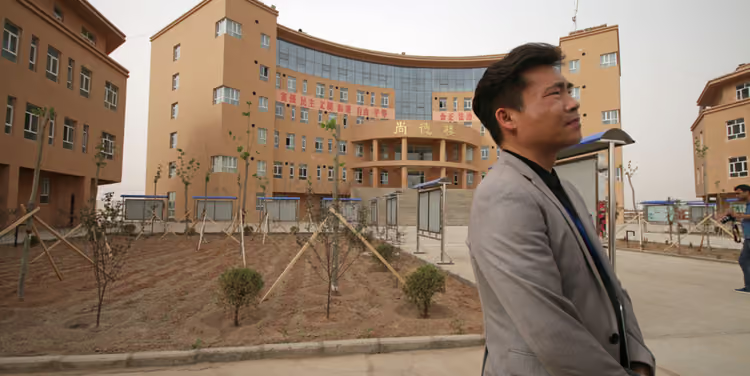
The UK government is introducing new rules to prevent the import of goods suspected of using forced labour in China’s Xinjiang province.
Foreign secretary Dominic Raab told the House of Commons on Tuesday that companies would have to make sure their supply chains are free from forced labour in the Xinjiang province or risk fines.
Raab told parliament there was harrowing evidence of human rights violations in Xinjiang against over a million Uyghur Muslims and that Britain had a moral duty to respond.
China has denied that any such human rights violations are taking place.
Raab said: “Xinjiang’s position in the international supply chain network means that there is a real risk of businesses and public bodies around the world – whether it’s inadvertently or otherwise – sourcing from suppliers which are complicit in the use of forced labour.
“Allowing those responsible for these violations to profit, or indeed making a profit themselves by supplying the authorities in Xinjiang.
“This package put together will help make sure that no British organisation, government or private sector deliberately or inadvertently are profiting from or contributing to human rights violations.
“The overwhelming majority of British businesses would not dream of it. Today’s new regulations will penalise any reckless business that does not take those regulations seriously.”
UK companies will be given robust and detailed guidance on conducting effective due diligence to make sure they do not source products linked to Xinjiang.
Raab said Britain will check sourcing from companies more thoroughly and strengthen the operation of the Modern Slavery Act, with the introduction of fines for businesses that do not comply with their transparency obligations.
The government will also conduct a review of export controls to prevent companies providing products to Xinjiang camps. Any countries that do not comply with procurement rules will be barred from government contracts.
Raab said: “Here in the UK, we must take action to make sure that UK businesses are not part of the supply chains that lead to the gates of the internment camps in Xinjiang.
“And to make sure that the products of the human rights violations that take place in those camps don’t end up on the shelves of supermarkets that we shop in here at home, week in week out.”
The move is likely to further strain ties between London and Beijing.
In the last year, tensions have grown between the UK and China over Beijing’s heavy-handed approach to democracy demonstrations in Hong Kong.
In July, the UK suspended its extradition treaty with Hong Kong and blocked arm sales to the territory after China imposed a tough new security law on the former British colony.
The government has also ordered Chinese tech giant Huawei to be removed from the UK 5G network by 2027 over concerns the Chinese government could use the company for spying.