.svg)
18 December 2025
Jack Grogan-Fenn
18 December 2025
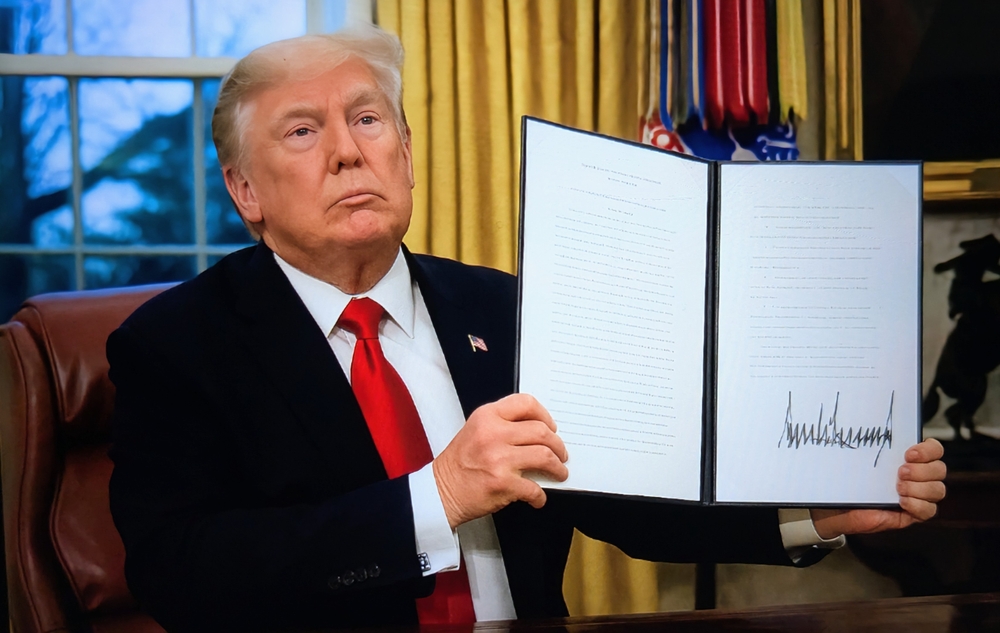
US President Donald Trump has introduced an executive order instructing the US Securities and Exchange Commission (SEC) to “review all rules, regulations, guidance, bulletins, and memoranda relating to proxy advisors” and the Federal Trade Commission (FTC) to “review ongoing State antitrust investigations”.
Signed last Thursday, the “Protecting American Investors from Foreign-owned and Politically-motivated Proxy Advisors” executive order alleges that two “foreign-owned” proxy advisors “regularly” use their substantial power to advance and prioritise “radical politically-motivated agendas” such as environmental, social and governance (ESG) and diversity, equity and inclusion (DEI).
Key Client Takeaways:
Trump Targets Proxy Advisors, ESG and DEI
Pushing Political Pressure
Minerva Analytics Defend Independent Advice
The executive order instructs SEC Chairman Paul Atkins to review current proxy advisor-focused legislation and “consider revising or rescinding” those which are “inconsistent” with the purpose of the order, especially to the extent that they include DEI and ESG policies. It tells the FTC to collaborate with Attorney General Pam Bondi to evaluate ongoing State antitrust investigations into proxy advisors and “determine if there is a probable link between conduct underlying those investigations and violations of Federal antitrust law”. The order also requests the Secretary of Labor to take steps to “revise all regulations and guidance regarding the fiduciary status of individuals who manage, or, like proxy advisors, advise those who manage, the rights appurtenant to shares held by plans covered under the Employee Retirement Income Security Act of 1974 including proxy votes and corporate engagement”.
“An attack on independent advice is an attack on investor voice,” warned Sarah Wilson, CEO at Minerva Analytics. “While Minerva competes vigorously with fellow proxy advisors, we share a common principle: investors must remain free to set their own policies and access independent research. Restricting that choice undermines stewardship sovereignty and ignores the risks to fiduciary duty, market integrity, and ultimately the retirement security of millions.”
The executive order claims that “investor returns should be the only priority” for proxy advisors. With investors, boards and assurance functions increasingly requiring documented, quantitative treatment of climate drivers, the US Administration's announcements reflect a fundamental misunderstanding of how investors, insurers and actuaries are embedding systemic sustainability risks.
Minerva Analytics rebuts the executive order’s insinuation that proxy advisors have undermined investor returns, with this allegation framing stewardship as harmful to financial outcomes. We believe that transparent, client-defined stewardship and voting supports risk-adjusted returns and accountability, while ignoring governance failures and systemic risks can destroy value, including for investors.
The executive order criticises proxy advisors for having supported shareholder proposals requiring American firms to undertake racial equity audits and “significantly” reduce greenhouse gas emissions. It also alleges that the practices of proxy advisors “raise significant concerns about conflicts of interest and the quality of their recommendations”. The order stated that the US “must therefore increase oversight of and take action to restore public confidence in the proxy advisor industry, including by promoting accountability, transparency and competition”.
“Our vision has always been for Minerva to empower investors with bespoke, transparent guidance aligned to their own policies,” said Minerva’s Wilson. “We support oversight that enhances transparency and competition while safeguarding investor freedom of speech and independent analysis. That's why we helped to co-found the Best Practice Principles Group and have been vocal advocates for fixing the broken proxy plumbing so that issuers and investors can connect.
“Bad myths do not make good regulations,” she added. “Minerva will therefore continue delivering 100% client-defined guidance with explicit rationales and will work constructively with stakeholders across the board to protect the integrity of shareholder voting.”
This year, Trump and Republican-run states – Texas in particular – have targeted ESG and DEI, including proxy advisors, asset managers and others who have refused to backtrack on these principles to the extent expected by the former parties. DEI has particularly been in the crosshairs of Trump and his administration, with some having stuck with DEI in the face of this political pressure, while others have looked to fight back.
A lawsuit filed earlier this month by four federal workers alleges that the Trump administration had illegally fired workers for their “perceived political affiliation” and “advocacy or perceived advocacy for protected racial and/or gender groups”. The lawsuit stated that Trump’s anti-DEI-related directives are “targeted actions intended to punish perceived political enemies, as well as to eliminate from the federal workforce women, people of colour, and those, like Plaintiffs, who advocated for or were perceived as advocating for protected racial or gender groups”.
The US SEC last month also made the controversial decision to not respond to company no action requests to exclude shareholder proposals during the 2026 proxy season, as reported by Minerva Analytics. This is expected to most acutely effect ESG- and DEI- related proposals, but it may also impact anti-ESG resolutions. Earlier this month, Costco opted to include a shareholder proposal in its 2026 proxy statement from an anti-ESG proponent despite previously submitting a ‘no action’ request to the SEC to exclude the resolution, as reported by Minerva Analytics. Accepting this resolution from an anti-ESG proponent despite being a defender of DEI signals a commitment to shareholder engagement, one which other companies would do well to follow during the forthcoming 2026 proxy season.
You can read more of our articles by clicking here.








.jpg)