.svg)
13 October 2019
Elizabeth Pfeuti

Asset owners must have the courage of their convictions to push forward with ESG policies – particularly when relevant data is hard to come by.
That was one of the overarching messages from a panel hosted by Minerva Analytics’ Sarah Wilson at the first Responsible Asset Owners Global Symposium featuring Denise Le Gal, chair of the Brunel Pension Partnership, Christian Kopf, head of fixed income at Union Investment, and Saker Nusseibeh, chief executive of Hermes Investment Management.
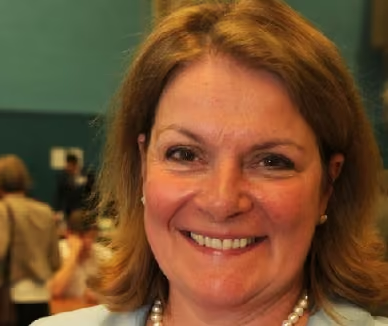
Le Gal, who has chaired the UK Local Government Pension Scheme asset pool for three years, said her organisation had established a clear value proposition and “common sense of purpose” that had helped Brunel challenge its providers and encourage positive action on ESG issues.
“In order to change things, you have to find people who are
like-minded and who have the same resolve,” Le Gal said. “Then, hopefully, you
can carry other people with you as they see the strength of your convictions.”
This courage was particularly important given that
conclusive or reliable data was not always available in some areas of
investment, she added.
“We’re in the fourth industrial revolution,” Le Gal
continued. “When this has happened before people didn't have data to forge
ahead. You have to have courage and conviction – and sometimes you just have to
trust your instincts. It's a real question of us being brave.”
When Le Gal joined Brunel three years ago, there were some
responsible investment sceptics among its 10 pension fund clients. However,
they have all since requested training on the subject following pressure from
their beneficiaries – a pressure that is only going to increase.
“They’ve been feeling pressure for some time, but the scale
and the momentum that we’ve seen, particularly last year, is not going away,”
Le Gal said.
The two asset manager representatives explored ways in which
the investment industry could drive change at various stages of the
distribution chain.
Union Investment’s Kopf explained how he had set his 60
fixed income portfolio managers performance targets linked to improving their
portfolios’ ESG scores, with remuneration also linked to their success.
One the subject of data transparency and quality, Kopf said
bondholders should ensure emissions data and other disclosures were included in
the terms of bond contracts and covenants to force companies to take data
demands seriously.
Other speakers throughout the day also encouraged bond
investors to be more proactive. In a keynote speech, Knut Kjaer, founder of
Norway’s giant sovereign wealth fund, urged investors to treat new bond issues
like new IPOs and put each issuer under the same scrutiny as they would new
equity listings.
The EU’s work on a sustainable finance taxonomy could also
help in fixed income and other asset classes, Union Investment’s Kopf said,
through setting standards on carbon disclosure in different industries. The
taxonomy could also help set standards as to what constituted a sustainable
asset manager, he added, given the varying definitions used by different
providers.
However, Hermes’ Nusseibeh warned that the high level of
interest in the taxonomy “is indicative of an industry that has grown up on the
idea that you have to measure things and put them in boxes”.
“All that means is ultimately everybody gets to say, ‘I meet
all these criteria, therefore it's all okay’,” he said.
Instead, Nusseibeh called for investors to focus less on the
short term and theoretical measures of risk such as volatility, and instead
look to have performance and risk horizons of at least 10 years. This would
focus investors’ minds on real risks such as climate change, he said.
Small actions up and down the distribution chain can have a cumulative effect, the panellists agreed. From voting shares and shaping bond covenants to securing consistent reporting from companies, asset managers and asset owners, each of these actions are achievable and serve to increase the momentum of positive change across the investment sector.
To find out how Minerva is helping Responsible Asset Owners with research, data and sustainable fund ratings say hello@minerva.info