.svg)
7 March 2025
Editor

March 7, 2025
As we enter March, the corporate world continues to gear up for the imminent 2025 peak season. Starbucks Corp’s AGM, scheduled for 12 March 2025, is a key meeting in the first half of the month where shareholders will vote on five shareholder proposals.
In this blog Minerva Analytics’ ESG Shareholder Analyst Daniel Kehoe examines Starbucks’ upcoming meeting and what shareholders can expect later this month.
Shareholders have filed five resolutions at Starbucks’ AGM this year, with three of them being ‘shadow proposals’ filed by anti-ESG organisations. This is in line with Minerva’s February blog post on shareholder proposals which also identified anti-ESG proposals at Apple’s and Deere & Co’s AGMs.
The five proposals are:
As an example of a ‘shadow proposal’, which uses similar wording to a pro-ESG proposal but with a political and anti-ESG angle and supporting statement, item 6 takes the approach that Starbucks faces risks posed by antagonistic union organisers.
These could result in Starbucks capitulating to their demands, which may threaten the rights of many of the company’s employees and could diminish shareholder returns.
This stands in contrast to the successful shareholder proposal at Starbucks' 2023 AGM which asked for an independent third-party assessment of the company’s adherence to its stated commitment to workers’ freedom of association and collective bargaining rights. The proposal received 51.35% votes in favour and was filed and voted on amidst backdrop of allegations that Starbucks interfered with US workers’ right to organise.
Starbucks’ AGM has seen the number of shareholder proposals, and ratio of their shareholder proposals shift towards anti-ESG proposals in recent years. A similar trend was identified at Apple Inc recently, where all four shareholder proposals voted on were filed by anti-ESG organisations.
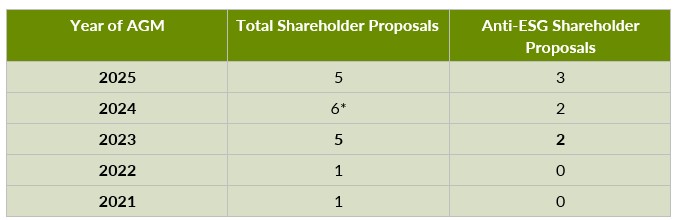
*The Strategic Organizing Center (SOC) withdrew three resolutions to appoint its director nominees at the 2024 AGM following an agreement with Starbucks Corp.
Table 1: Starbucks Shareholder Proposals (2021-2025). Source: Minerva Analytics Ltd
The debate around ESG and shareholder proposals is taking place in a new political and regulatory environment this year.
With Donald Trump returning to office, we have already seen the new administration make changes in several areas, as his office has already terminated DEI-related policies in the Federal Government and withdrew from the Paris Agreement.
Additionally, the U.S Securities and Exchange Commission (SEC) has also changed its legal guidance on the shareholder proposal review process and under what conditions a company can exclude a shareholder proposal from consideration in its proxy statement.
The SEC has also moved to drop its climate disclosure requirements for companies and introduced new rules on filing Schedule 13D disclosures for investors who engage on ESG issues. Given the evolving political and regulatory landscape, coupled with the recent surge in anti-ESG activism, shareholder proposals are expected to remain a highly polarised and contentious issue throughout 2025
As Minerva continues to monitor these developments, it will be intriguing to observe how Starbucks and their shareholders respond to the proposals. Historically, anti-ESG shareholder proposals have tended to receive low levels of support
Be sure to check back soon for our next upcoming shareholder proposal blog, which will cover the second half of March. We will be looking at some key upcoming AGMs and proposals, including Walt Disney, A.P. Møller-Mærsk, and several major Nordic banks such as Danske Bank, Nordea Bank, Svenska Handelsbanken, and Swedbank.
You can read more of our articles by clicking here.




.png)

Alex Whitebrook