.svg)
20 August 2021
Elizabeth Pfeuti

Guidelines are expected to provide help corporates and governments in developing economies design and implement green bonds.
August 20, 2021
A group of emerging markets investors have put forward new guidelines for issuers of labelled green bonds in a push to strengthen this nascent market in developing economies.
The Emerging Markets Investors Alliance (EMIA) has developed the standards amid concerns of greenwashing as governments and corporates increasingly turn to the green bond market to raise capital.
According to the EMIA, the enhanced guidance offers “more specific and granular guidance” for emerging market labelled bond issuers and investors.
In particular, the standards introduce tighter rules on the use of proceeds, processes for project evaluation and selection, and the management of proceeds and post-issuance reporting.
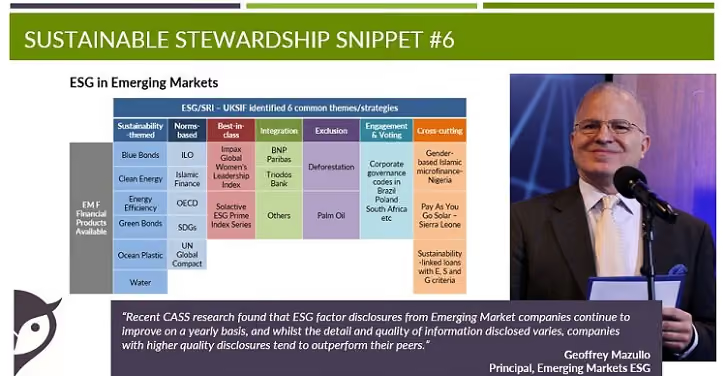
Find out more about tackling greenwashing on Minerva's YouTube channel:
Proceeds must be used 100% in line with their designated uses as laid out in the bond documentation, the EMIA stated, while sustainability bonds must clearly state green and social usages prior to issuance. Capital raised should be ringfenced to prevent usage in expenditure costs.
Proceeds from such bonds cannot be used to refinance other bonds, the standards indicate, with the exception of projects that have “retained their economic value”.
Further, selection processes must be “inclusive” and exhibit “community or grassroots involvement” at the formulation stage. They must also prove “intended and unintended impacts” on environmental, social and governance factors, with the supply of proof to be directly led by the issuer.
In the past, a lack of standards has led to application of the green label to fixed income products without proper evaluation of their uses. However, organisations such as the Climate Bonds Initiative have sought to establish global standards and minimum requirements.
The European Union's taxonomy for sustainable activities also sets out six objectives that fixed income investment activities must meet if they are to be considered truly green.
Further reading: Minerva briefing - Greenwashing
Sign up for Minerva's upcoming Webinar - Sustainable securities lending: the next greenwashing scandal in the making?