Sustainable Stewardship Snippet 6: ESG Factors & Emerging Markets

4 March 2020

Editor

Latest News

Australia narrows climate reporting scope mid‑rollout

Minerva Proxy Update

Follow This challenges Shell days before key vote

SRD III is Europe’s chance to fix proxy plumbing

SEC Steps Closer to Unwinding Climate Disclosure Rules

Minerva Proxy Update

Featured Briefings

Australia Proxy Season Review 2025

2026 Proxy Season Preview

Diversity Divergence: Shareholders Steadfast Amid Pervasive Political Posturing

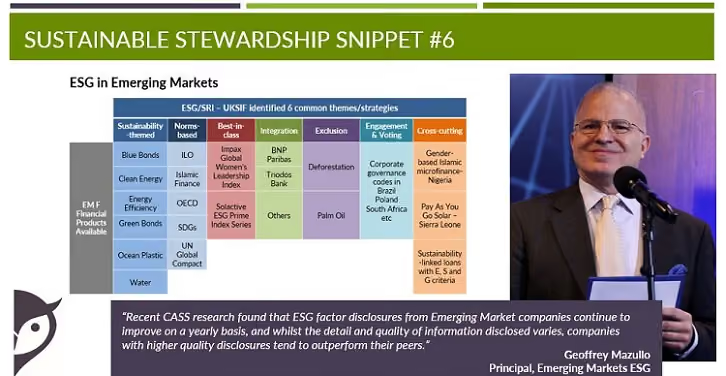
Whilst, in broad terms, ESG factor disclosures by companies in Emerging Markets is not yet at the level of Developed Markets, it continues to improve, and indeed what we now think of as ESG factor considerations have been present in the running of such companies for many years, according to Geoffrey Mazullo of Emerging Markets ESG.

At Minerva’s recent ESG Educational Event, Geoffrey delivered
a presentation looking at the origins of ‘ESG’ as a concept in Emerging Markets.
He highlighted recent investment history, when ‘Emerging Markets’ and ESG in
the form of ‘Socially Responsible Investment’ (SRI) were treated as different
investment choices by investment professionals. There were very few examples of
Emerging Market SRI products, beyond Islamic finance and micro-finance, which
were largely offered by boutique, specialized institutions.

Over the last decade, as the concept of SRI faded and a more holistic ESG factor approach rose to prominence, asset owners, asset managers and companies each had to look beyond their respective traditional remits of maximising financial return, investing based on financial attributes and maximising shareholder value. This has resulted in increased awareness of sustainable investment, with Emerging Market ESG now being driven by:

  • Corporates: From governance of governance to governance of ESG as well as financial internalities and externalities;
  • Investors: Demand for emerging markets ESG products and services – commercial lending, commodities, deposits, equity, fixed income, real estate and sovereign;
  • Regulators: Corporate governance codes;
  • Service Providers: Mainstream service providers’ acquisition of boutique service providers with emerging market coverage;
  • Explosion of emerging market ESG indices:  Brazil, China, Chile, Egypt, Hong Kong, India, Israel, Mauritius, Mexico, Peru, Poland, Russia, Singapore, South Africa, South Korea, Taiwan and Turkey as well as global emerging markets and regional;
  • Stock Exchanges: Mandatory or voluntary ESG disclosure; and
  • Technology: Clean cookstoves, fintech, biomass, solar, wind.

Geoffrey concluded by expressing his view that modern ESG in Emerging Markets is driven by a recognition – by companies and their investors - of ESG factors being internalities that impact operational performance, financial performance, risk management and stakeholder engagement.

For more information on how Minerva is helping asset steward
get to grips with their new ESG responsibilities, and stay up to date on latest
developments, say hello@minerva.info

Related Stories

Judge rules American Airlines unlawfully considered ESG factors in 401(k) plan

January 16, 2025

Elizabeth Pfeuti

Read More

Oklahoma advances amendments to controversial anti-ESG law

March 5, 2024

Elizabeth Pfeuti

Read More

US Republicans file lawsuit over ERISA ESG rule

January 26, 2024

Elizabeth Pfeuti

Read More

Asia's ESG ratings sector still developing, says OECD

January 21, 2022

Elizabeth Pfeuti

Read More

EM alliance unveils green bond standards

August 20, 2021

Elizabeth Pfeuti

Read More

CFA Institute: How to take the next steps in ESG integration

December 7, 2020

Elizabeth Pfeuti

Read More